|
Johnson's Backyard Garden Transplants for Sale!
 The Greenhouse
Johnson's Backyard Garden is excited to offer certified-organic heirloom vegetable transplants ready to plant in your spring garden! Heirloom seeds have been saved from generation to generation and are renowned for their superior taste and beauty. Many of the varieties available from JBG are listed in Slow Food's Ark of Taste and are in danger of extinction. By promoting and eating these heirlooms, you help ensure they remain in production and on our plates. This winter JBG launched an extensive search to find a supply of these rare, unique seeds. In partnership with Slow Food, we're offering Ark of Taste varieties to promote awareness and enjoyment of these storied vegetables. Learn more about the project in the upcoming summer issue of Edible Austin. We plan to plant heirloom varieties on the farm and will include the produce in future CSA boxes as well as sell it at local farmers' markets.
Saturday, March 6 - Join Slow Food Austin for a farm tour of JBG! Brenton will show participants around the greenhouse and fields and lead a discussion about organic farming in Austin. Tickets are $16, which includes the tour, talk and transplants to take home.
RSVP to education@slowfoodaustin.org.
Instructions:
Transplants are available in either 4" pots or 6-packs. If a 6-pack sounds like a lot, remember you can always share plants with friends or neighbors. The cost for a 4" pot is $3; a 6-pack is $10. This year we're also offering farm-selected sampler packs that offer an assortment at a great price! The table below lists our current availability. Please check back regularly as our greenhouse stock is updated weekly.
There's a minimum $20 order to deliver transplants along with your CSA box to your weekly pickup site. If you are not a member, orders are self-serve pickup at the farm Tuesday, Wednesday or Friday afternoons until 7 p.m. in front of the greenhouse.
To order through our website, simply add selections to your online cart and enter your payment information through Google Checkout.
To ensure your order has been processed, please place your order at least 1 day prior to pickup and make sure you receive a confirmation email from Google.
Email sarah@jbgorganic.com with any questions or if you'd like to pay by check.
Jump to: Tomatoes, Tomatillos, Peppers, Eggplants, Melons, Squash, Lettuce
 |
Aunt Ruby's German Green
Aunt Ruby's German Green is a sweet, juicy tomato with a piquant bite. This heirloom is a large, beefsteak-type tomato that is pale green with a hint of yellow striping. The tomato often weighs one pound or more. Aunt Ruby's German Green has the wetness of a melon and can give a deep flavor explosion. It is generally used in salads but is also a wonderful tomato to fry.
|
 |
Chalk's Early Jewel
This heirloom was bred by James Chalk of Norristown, Pennsylvania, and introduced in 1899. Its seed was introduced commercially in 1904 by the Stokes Company. The variety features a deep red exterior and a meaty, tender interior. When eaten raw, it is juicy with a great acidity and is spicy without being sour.The Chalk's Early Jewel tomato is 3-4" and produces early, about 60 days.
|
 |
Cosmonaut Volkov
A Ukrainian heirloom variety named after the famous Russian cosmonaut who died while landing. Russians grow this variety for prize-winning, 1-2 pound fruits. Round, slightly flattened fruit has a full, complex flavor and nice acid-sweet balance.
|
 |
German Pink
The German Pink tomato is a Bavarian variety that is currently grown in Festina, Iowa. The plants produce large, 1-2 pound meaty fruits with few seeds. The German Pink tomato has a sweet flavor, even floral, and it is tender-skinned. The tomato is an extremely versatile fruit, excellent for canning and freezing but also for slicing and juicing.
|
 |
San Marzano
Tall vines produce heavy yields of long, cylindrical fruit a week earlier than other San Marzano varieties. Delicious, balanced acidic flavor, and meaty flesh makes for good sauce. Fruits grow to 5-6 oz. on average. High-quality paste tomato. Indeterminate.
|
 |
Red Fig
These 1.5" pear-shaped tomatoes have been grown in the US since the 18th century. Traditionally they were dried and packed away for winter use as a substitute for figs. They are also used fresh. To make the "figs," boiling water was poured over the tomatoes to remove the skins, and then the skinless tomatoes were placed in a jar with equal parts sugar to tomatoes. The resulting syrup was then removed from the jar and boiled and skimmed. The process was repeated over two days, with intervals of cooling. Finally, the tomatoes were dried in the sun for about a week, at which point they were packed in small wooden boxes with fine white sugar between every layer. Tomatoes prepared in this manner were said to keep for years.Fresh Red Figs have a full tomato taste with very sweet skin. In addition to being delicious on its own, this variety is perfect for tomato jams and chutneys.
|
 |
Sheboygan
The Sheboygan tomato has been grown since the early part of the 20th century in Sheboygan, Wisconsin, by Lithuanian immigrants. It produces 4-6 oz. paste fruit that is good for eating fresh or for canning. Its strong flavor is similar to other heirloom varieties rather than paste tomatoes. This variety has complex flavor and a great balance of sweetness and acidity.
|
 |
Suddith Strain Brandywine
The Suddith Strain Brandywine tomato is one of the best-tasting heirloom tomatoes available to gardeners today. It has an incredibly rich, delightfully intense tomato flavor. When ripening on the vine, its flesh bulges out of its skin. The tomatoes are large, pink, beefsteak fruits weighing up to 2 pounds.
|
 |
Beaver Dam
Hungarian heirloom pepper that was brought to Beaver Dam, Wisconsin, in 1912 by the Joe Hussli family. Seed is available from just a handful of mail-order seed companies in the US and Canada, and its future is largely in the hands of these seed-saving companies. Rated as 3 on a heat scale of 1-5, the Beaver Dam is great for making fresh batches of cool and tangy salsa. When seeded, they have an excellent flavor. The pepper's first fruits mature 80 days after transplanting, at which point they ripen from green to red.
|
 |
Bull Nose Large Bell
Early sweet bell heirloom that was prevalent in the 1800s. Only five seed companies offered this seed for sale in 2004, down from 20 sources in 1981.These crunchy peppers are fun to eat raw, and the walls are thick enough to hold a hearty dip. And, of course, they're delicious pickled. The pepper matures from green to scarlet. It can be used green, but is sweeter when red. 55-80 days from transplant.
|
 |
Serrano
Small, finger-shaped, hot peppers picked green or red. Easy to dry. Space plants 18-24" apart. Grow in full sun. 75 days.
|
 |
Fish Pepper
Pre-1870s African-American heirloom. Beautiful variegated foliage on 18-24" plants. 2-3" fruits ripen from cream with green stripes to orange with brown stripes to all red. Heat is rated a 3 on a scale of 1-5. Traditionally used in oyster and crab houses around Chesapeake Bay. Perfect for salsa. 80 days from transplant.
|
 |
Hinkelhatz Hot
Cultivated by the Pennsylvania Dutch for over 150 years, also known as Chicken Heart.Heat is rated a 4 out of 5. Traditionally used extensively for pickling and making pepper vinegar. Ripens from green to red, fruits measure ¾" wide by 1½" - 2" long. 90 days from transplant.
|
 |
Jimmy Nardello's Sweet Italian Frying Pepper
This variety of pepper was originally from Basilicata, a southern region of Italy. Its namesake, seed saver Jimmy Nardello, brought the seeds from Italy when he immigrated to Connecticut in 1887. Fruit is sweet and light when eaten raw. It is considered one of the very best frying peppers, becoming creamy and soft when fried. Fruits are 10-12" long, and the plants can reach 24". 80-90 days from transplant.
|
 |
Habanero
The famous 10-alarm pepper from the Caribbean. Said to be the hottest of all peppers, its name means "from Havana." Habanero long ago migrated from the Caribbean Islands to Central America, where it remains extremely popular today. To complement its searing heat, Habanero has a delicious, pungent, smoky quality unlike any other pepper. Many people find its flavor and aroma irresistible in sauces and salsas. The short, wrinkled, green fruits (1-1/2" long by 1" wide) turn orange. Space plants 18-24" apart. Grow in full sun. 95 days.
|
 |
Sheepnose Pimento
The Sheepnose pimiento is an Ohio heirloom. A watery chile pepper with a rich, meaty flavor. The pepper has a mild, tangy flavor and rates 0 on a 1-5 heat scale. The Sheepnose Pimiento is generally used for canning and cooking.
|
 |
California Wonder
Heirloom. The standard sweet bell pepper that's popular in gardens. One of the best for stuffing - a blocky 4 x 3-1/2", thick-walled, tender and flavorful pepper. 75 days.
|
 |
Hungarian Hot Wax (Banana)
Fairly hot variety that typically grows 8"-long, tapered fruit. Great for pickling or drying. Canary yellow turning to bright red when ripe. CAUTION: Use rubber gloves or clean hot peppers under running water to avoid burning skin. Harvest starts about 70 days after setting out plants.
|
 |
Rosa Bianca
Stunning Italian heirloom. Beautiful fruits are prized by chefs. Meaty 4-6" round fruits have a mild flavor and are almost never bitter. This variety is well-suited for all your cooking needs, especially Eggplant Parmigiana. 70-85 days from transplant.
|
 |
Black Beauty
Nearing 100 years old, this 1902 Burpee introduction remains a standard worldwide for large-fruited black eggplant. It was an immediate hit because the plants ripen perfect fruits dramatically earlier than other varieties. Black Beauty is the common market eggplant of today. Harvesting fresh makes all the difference in its flavor. 74 days.
|
 |
Ping Tung Long
Extremely beautiful eggplant that originated in Pingtung, Taiwan. Dark lavender fruits have an incredible shine that radiates off the skin. Slender fruits up to 12" long and just slightly more than 1" in diameter. Hardy, vigorous plants are disease resistant.65-75 days from transplant.
|
 |
Boston Marrow
This lovely winter squash originated in Upstate New York. Legend has it that Native Americans gifted the vegetable to European-descended gardeners. The seeds were later passed on to Salem, Massachusetts, in 1831, where the Boston (or "Autumnal") Marrow Squash was then popularized. Fruit is prized for its rich, orange flesh with a fine texture and custard-like, buttery flavor. It was primarily used in New England as a pie squash. This variety matures in 90 to 100 days and has striking, reddish-orange skin. Fruit averages 10 to 20 pounds, though it can grow larger. A good storage crop -- if kept in a cool, dry place, it will last until the following spring.
|
 |
Sibley
The Sibley Squash, also known as Pike's Peak, was obtained from a woman in Van Dinam, Iowa, who had grown it more than 50 years. Hiram Sibley & Co. of Rochester, New York, introduced the variety commercially in 1887. Sibley is a Hubbard-type squash with moderately vigorous 12-15' vines. The slate-blue, teardrop-shaped fruits have very shallow ribs and weigh 8-10 pounds. Its medium-thick orange flesh is flavorful and sweet. The flesh becomes drier and richer with storage, reaching its peak right after the New Year.
|
 |
Lettuce Mix
2 Grandpa Admire's Lettuce,
2 Speckled Lettuce,
2 Tennis Ball Lettuce
|
 |
Grandpa Admire's Lettuce
Bronze-tinged leaf lettuce that forms large loose heads. Mild fine flavor, slow to bolt, tender longer than most, even in extreme heat. George Admire was a Civil War veteran born in 1822. In 1977, 90 year-old Cloe Lowrey, Grandpa Admire's granddaughter, gave this seed to SSE. Butterhead, 60 days.
|
 |
Speckled Lettuce
This variety was sent to the Seed Savers Exhange in 1983 by Mark Reusser. His father obtained it from Urias Martin, whose Mennonite family brought it to Waterloo County, Ontario, in 1799 in a covered wagon from Lancaster County, Pennsylvania. The Martin family immigrated to America from Germany, and earlier from Holland in 1660. Looseleaf, 40-55 days.
|
 |
Tennis Ball Lettuce
This variety was introduced to gardeners in the 1850s, and went on to be listed by 116 seedsmen in 1904. Small tight rosettes of light green leaves. The plants measure 7" in diameter and form loose heads. According to Heirloom Vegetable Gardening by SSE member William Woys Weaver, tennis ball lettuces were often pickled in salt brine during the 17th and 18th centuries. Black seeded. Butterhead, 50 days
|
|
 Share this with a Friend

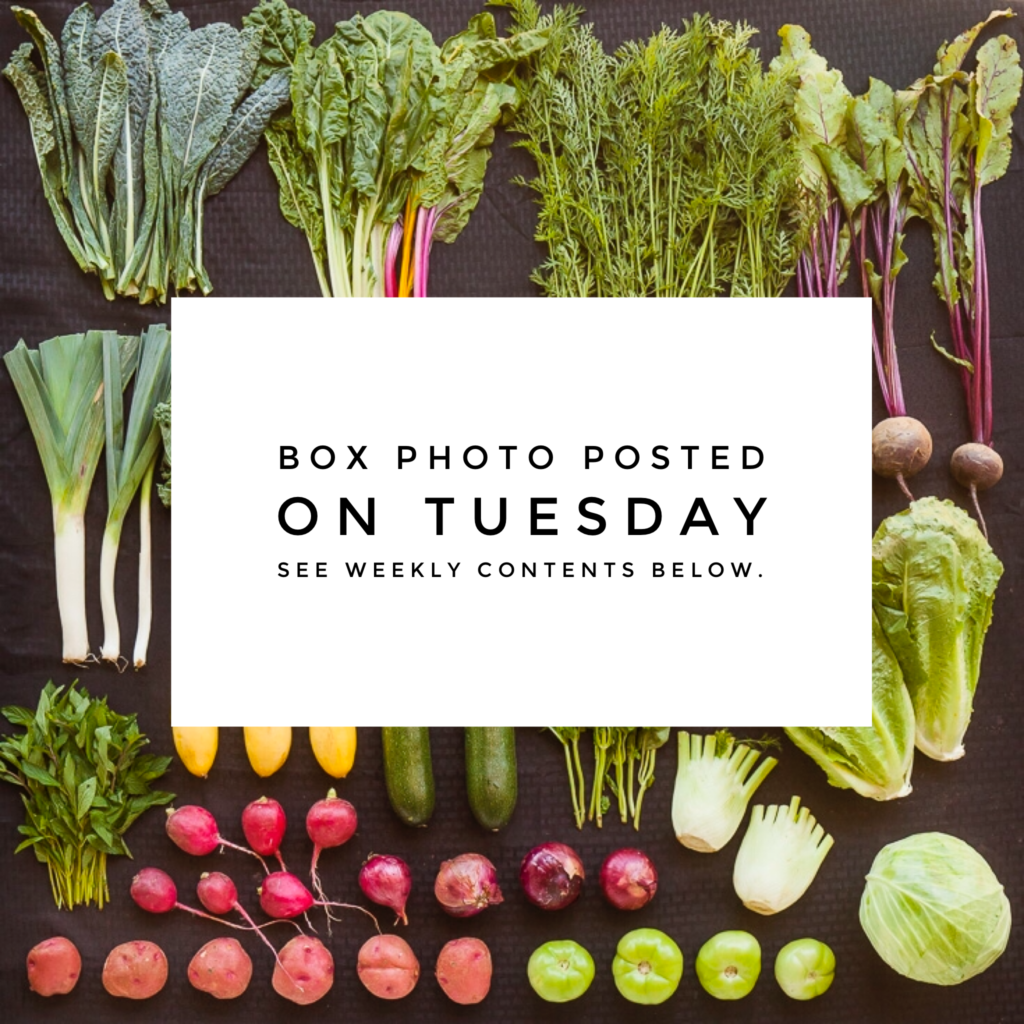
Our Best Guess for Tuesday, July 27th through Sunday, August 1st
Week 31
Purple and Black Eggplant
Sweet and Hot Peppers
1015 Onions
Okra
Basil
Mint
Melon (maybe!)
Summer Squash
Kabocha or Acorn Squash
Garlic
|

Arugula
Basil
Cantaloupe
Eggplant
Okra
Mint
Purple Hull Peas
Sweet and Hot Peppers
Squash
Sweet Potatoes
Tomatoes
Watermelon
Winter Squash
Zucchini
|
|